MA 3 – President Simulator
- 4.4
- Rating
- 1.00M
- Installs
- Free
- Price

 Analysis by App-foxy
Taking the role of a national leader is an easy premise to understand, but a difficult one to make interesting over time. MA 3 – President Simulator puts that responsibility at the center of a strategy game from Oxiwyle Inc, asking me to think beyond a single decision and consider how one choice can affect the direction of a modern country. My first impression was that it aims for a serious political mood rather than a light arcade experience, yet it remains approachable enough for someone who normally plays strategy games on a phone.
The free entry point helps. I could try the central idea without committing money first, while the age rating of Everyone 10+ makes its presentation suitable for a broad audience. It is available for devices running Android 7.0 or later, and the current version is 1.0.70. The game has already reached over a million installs and holds a 4.4 average from around 36 thousand ratings, which suggests that its basic presidential-simulation concept has found a substantial audience.
What matters more to me than those figures is whether the game makes leadership feel like a series of meaningful trade-offs instead of a collection of disconnected buttons. In that respect, the experience is most enjoyable when I slow down, read the situation in front of me, and accept that a decision that looks helpful immediately may create a more complicated problem later. It is not the kind of strategy game I would open only for a quick burst of action. Its appeal comes from building a mood of responsibility and then letting the consequences occupy my attention.
You May Also Like

 Blood Strike: 2.5 Anniversary
Blood Strike’s Loadouts Turn Every Drop Into a Tactical Gamble
A close look at Blood Strike’s custom loadouts: how fast access to signature weapons reshapes its battle royale rhythm, rewards preparation, and narrows the gap between fights.

 Pandora - Music & Podcasts
Pandora’s Music Is Easy to Start, but Harder to Recover
Pandora’s strength is its low-effort path from a seed to a station. Its weak spot is how much confidence it asks you to place in connection, setup, and quiet recovery.

 8 Ball Pool
 Is Built on Rivalries, Rematches, and Routine
A close look at the rivalries, rematches, shared routines, and unanswered safety questions that turn a quick pool match into a persistent mobile community.

 Samsung Music
’s Quiet Strength Is Playing What You Already Own
Its reach comes less from spectacle than from dependable access to a personal library. That simplicity is both the app’s strongest retention engine and its ceiling.

 AccuWeather: Weather Radar
AccuWeather Review: A Quick, Clear Forecast for Everyday Decisions
For everyday plans, the best forecast is the one you can understand quickly. AccuWeather makes rain timing, radar, and local conditions easy to act on, with a few trade-offs.

 Hill Climb Racing
Why Hill Climb Racing Still Turns Crashes Into One More Run
A tiny car, a bumpy hill and one more upgrade: Hill Climb Racing keeps resurfacing because its simple chaos makes every near-miss feel personal.
More From Our News Desk



Entering a modern presidency
The setting does a lot of work before the deeper strategy has time to settle in. I am not managing a fantasy kingdom or a distant science-fiction colony. I am dealing with the recognizable idea of a contemporary nation, which gives ordinary choices a sharper edge. A decision about national priorities feels more personal when it resembles a problem that could appear in a real headline, even though the game remains a simulation rather than a political textbook.
That modern framing also makes the opening easier to understand. I do not need to learn a large fictional universe before I can appreciate what is at stake. The role is immediately clear: I am the president, and my job is to guide the country through competing pressures. This clarity is one of the strongest parts of the presentation. The game knows that the fantasy of leadership is already enough to attract attention, so it does not need to bury the premise under unnecessary lore.
At the same time, the setting creates a demanding expectation. Players who want a highly detailed political simulator may find the mobile format more focused than a full desktop grand-strategy game. The experience is better approached as a readable, decision-driven interpretation of national leadership than as a complete model of government. That distinction matters, because it explains both its accessibility and its limits.
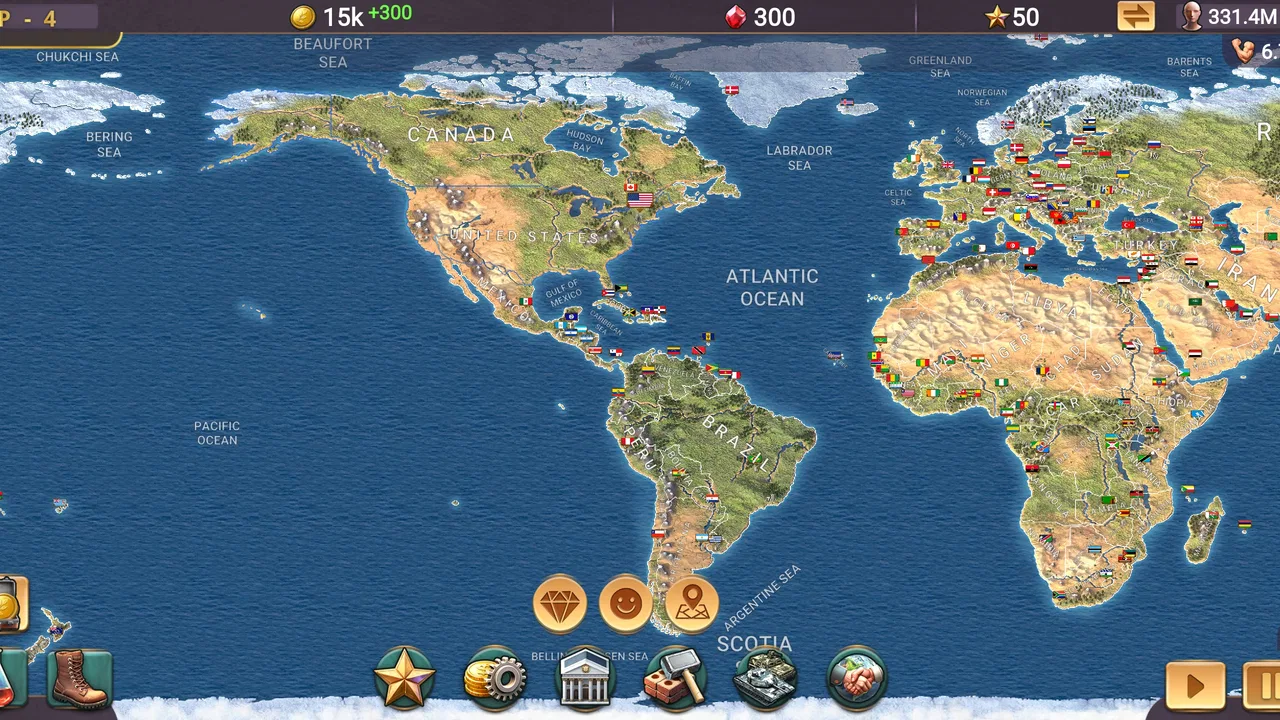
I found the visual direction most effective when it supports that restrained political tone. The presentation feels designed to keep my attention on the country and its problems rather than on flashy spectacle. That choice suits the subject. A loud, colorful style could have made the presidency feel like a novelty, while the more serious framing encourages me to treat each turn or decision as part of a larger story.
There is also a useful contrast between the scale of the role and the scale of the device. On a phone, I can hold the entire idea of governing a nation in my hand, but the interface still needs to translate a complicated responsibility into information I can absorb. The best moments are those in which the game gives me enough context to make a considered choice without demanding that I study a manual first.
Why the setting works better than a generic strategy backdrop
A common weakness in mobile strategy games is that the setting becomes decoration around familiar systems. Here, the presidential premise gives the decisions a recognizable emotional language. I am not simply improving a base or collecting resources. I am trying to maintain direction while different national needs pull against one another. That creates a more grounded kind of tension.
For example, the game is especially suited to a short evening session in which I want to think rather than react. I can begin with the intention of making one or two sensible choices, then find myself reconsidering the wider effect of a policy direction. If I am playing while commuting or waiting for an appointment, I can stop when the immediate decision is complete. If I have more time, I can continue and see whether my earlier priorities are holding together.
My practical advice is to avoid treating every decision as a simple test with one correct answer. The more interesting approach is to decide what kind of leader I want to be, then judge options against that intention. A choice that appears inefficient in the short term may fit a long-term political direction better than the option with the most obvious immediate reward. That mindset gives the game more depth than its compact mobile format initially suggests.
The language of the world and the feel of leadership
Art direction is important here because the game needs to communicate authority without becoming theatrical. The modern national setting works best when the visual language feels orderly, official, and focused. Even without relying on spectacle, the presentation can make the player feel that decisions belong to a larger public system rather than to a private puzzle board.
I appreciate that this kind of atmosphere leaves room for interpretation. The game does not need to tell me constantly that a choice is historic. The presidential role already supplies that context. When the interface presents a national problem in a direct way, I can fill in the emotional weight myself. That is more effective than exaggerated drama, especially for players who prefer strategy to storytelling.
The setting also affects how I read information. In a fantasy game, an unfamiliar term can be part of the fun. In a modern political simulator, unclear wording is more frustrating because I expect to understand the basic situation immediately. The strongest design choice is therefore the one that keeps the language practical: enough detail to explain why a decision matters, but not so much that the game becomes a wall of administrative text.
This is where the experience can divide players. Someone who enjoys spreadsheets, dense statistics, and highly granular systems may want more control than a mobile presidential game can comfortably provide. Someone who likes the idea of governing but does not want to spend hours learning a complex ruleset will probably find the setting more welcoming. I place myself between those groups. I want decisions to matter, but I also want the game to respect the limited attention available on a phone.
One useful way to play is to treat the country as a living conversation between priorities. Instead of asking only, “Which option gives me the biggest advantage?” I ask, “What does this choice say about the direction of my administration?” That small change makes the setting feel more coherent. It turns individual actions into part of a political identity, even when I am playing in short sessions.
Where the presentation earns its seriousness
The game’s strongest mood comes from restraint. The presidency is not presented as a personal power fantasy alone; it is framed as an ongoing responsibility. That makes the setting more playable because the tension comes from balancing outcomes, not merely from collecting victories. I feel more involved when the game asks me to live with the shape of my decisions rather than immediately rewarding every action.
There is a trade-off, though. A serious presentation can make slower moments feel even slower. If I am in the mood for constant motion, dramatic battles, or rapid visual feedback, this is not the right choice. Its world language favors reflection. I need to be willing to read, compare, and think about consequences before the atmosphere can work for me.
The free model also deserves attention when considering the overall mood. In-app purchases range from $0.49 to $99.99 per item. That broad range means the game is not simply a one-time purchase experience, and players who prefer a fully predictable cost structure may feel more comfortable with a premium alternative. I can recommend trying the free version first, but I would also advise deciding in advance whether optional spending fits the way I want to play.
Sound, pacing, and the shape of a session
Sound is easy to overlook in a strategy game because the main attraction is decision-making. In this case, the audio atmosphere matters precisely because the game is built around a serious role. A suitable soundscape can make a quiet decision feel deliberate, while an overly dramatic one would push the presidency toward melodrama. The overall mood works best when sound supports concentration instead of competing with the information on screen.
I would not choose this game for audio spectacle. Its appeal is not the kind of soundtrack that carries an action sequence or creates a cinematic climax. Instead, sound contributes to the impression that I am moving through an official, measured environment. That fits the modern political setting and helps the game feel more coherent when I am considering several options in succession.
Pacing is even more important. The game has a naturally stop-and-start rhythm because leadership is represented through decisions rather than continuous movement. That makes it well suited to mobile play, but only if I accept that the tension is gradual. A session may begin quietly, with me reviewing a situation, and become more engaging as the consequences of earlier priorities begin to shape what I face next.
This creates a useful everyday scenario. If I have ten minutes before leaving home, I can use the game as a focused mental break rather than expecting a complete campaign arc. I can make a decision, reflect on its direction, and put the phone away. Later, I can return without needing the game to provide a constant stream of action. That flexibility is a real strength for a mobile strategy title.
On the other hand, players who want instant feedback may find the rhythm too restrained. The game asks for patience, and patience is not the same as difficulty. I may understand a decision perfectly and still need time before its wider effect becomes interesting. That delay can make the experience feel thoughtful, but it can also reduce momentum if the current situation does not offer a compelling dilemma.
How to avoid making the pace feel flat
I get more from the game when I play with a clear question in mind. I might decide to focus on stability, public welfare, or a particular leadership style, then observe how the game challenges that intention. This gives each session a purpose and prevents me from tapping through choices without considering them. It also makes the pacing feel more personal, because I am following an argument about how a country should be run.
Another helpful habit is to pause before selecting the most attractive-looking option. In a presidential simulator, the obvious benefit may not be the only relevant factor. I look at the broader situation, consider what my earlier choices have prioritized, and ask whether I am solving a temporary problem or creating a new dependency. This is one of the most rewarding ways to turn a short session into meaningful strategy.
The game is less suitable for people who want a quick win every time they open an app. It is also not ideal if I am looking for a multiplayer contest or a highly kinetic strategy experience. Its rhythm is inward and administrative. The satisfaction comes from maintaining a direction under pressure, not from defeating an opponent in real time.
How the mechanics fit the presidential fantasy
The core mechanical idea is a good match for the setting because it makes leadership feel like prioritization. I am not simply building the strongest possible nation through one universal upgrade path. I am weighing what deserves attention and accepting that a government cannot satisfy every demand at once. That is the right foundation for a president simulator.
What I like most is the way the premise encourages consequential thinking. Even when a choice seems small, I try to imagine how it fits into the wider administration. This creates a stronger connection between mechanics and atmosphere than I would get from a generic resource-management game with a political skin. The national setting is not just a backdrop; it gives the decisions their meaning.
Still, the game should not be confused with a full-scale alternative to complex PC strategy titles. Those games often provide deeper diplomacy, more detailed economic models, larger maps, and a much wider range of long-term systems. MA 3 is more appropriate for someone who wants the fantasy of national leadership in a format that is easier to pick up. The trade-off is depth versus convenience, and the right choice depends on which side matters more to me.
Compared with a typical city builder, this game feels less focused on arranging physical space and more focused on the consequences of policy. Compared with a conventional war strategy game, it places less emphasis on direct conflict and more on governing pressure. Compared with an interactive political story, it offers more room for me to shape the direction of the country through play rather than simply follow prepared scenes.
That middle position is its identity. It is not trying to replace every other strategy format. It is for players who want a modern national setting, readable decisions, and a reflective pace. If I want to test whether I enjoy that combination, the free download makes the experiment straightforward. If I already know that I need deep simulation detail or a tightly authored narrative, I should choose a different genre before spending time on it.
Practical choices that improve the experience
My first recommendation is to play in focused sessions instead of tapping through while distracted. The game’s value depends on noticing how the leadership role changes the meaning of a decision. A second recommendation is to keep a consistent policy direction for a while before changing course. Constantly chasing the most immediate benefit can make the country feel reactive, while a clear direction makes the consequences easier to understand.
A third insight is that the game works well as a conversation starter with another strategy player. Two people can face the same general presidential fantasy and still make different choices because they value different outcomes. That does not require the game to become competitive. The interesting comparison is in the reasoning: one player may prefer cautious stability, while another may accept short-term disruption for a larger goal.
There is also a spending consideration. Because purchases can reach $99.99 per item, I would not approach the game with the assumption that every optional offer is necessary. I would first learn whether the basic loop holds my attention, then decide whether any purchase genuinely improves my experience. The game is easiest to recommend to players who are comfortable treating optional spending as a personal limit rather than as part of the core requirement.
For families, the Everyone 10+ rating gives the game a relatively accessible starting point, but I would still consider whether the child enjoys reading and weighing abstract consequences. The challenge is not only age suitability; it is also patience. A young player looking for immediate action may lose interest, while one who enjoys pretending to run a country could find the premise especially engaging.
Who should play it, and who should skip it?
I would recommend it to mobile players who enjoy strategy built around choices, national direction, and gradual consequences. It is a good fit for someone who likes the idea of a serious role-playing frame without needing a sprawling fantasy world. It also suits people who prefer sessions that can pause naturally instead of demanding continuous attention.
I would be more cautious recommending it to players who need transparent, highly detailed systems at every step. If my enjoyment depends on seeing a deep economic model, precise military planning, or a large diplomatic sandbox, this may feel too streamlined. Likewise, anyone who dislikes in-app purchase models should examine the free experience carefully and keep the listed purchase range in mind before becoming invested.
The developer, Oxiwyle Inc, has chosen a premise with enough flexibility to support different play styles, but that flexibility depends on the player bringing some imagination to the role. I get the most from it when I decide what kind of president I want to be and let that guide my choices. If I only search for the mathematically strongest action, the atmosphere loses some of its value.
The game also benefits from being approached as a mood-driven strategy experience. Its art direction, modern setting, sound, and measured rhythm all point toward the same idea: governing is less about one spectacular moment than about maintaining a course while pressures accumulate. When those elements line up, the game feels more distinctive than its simple store summary might suggest.
My overall view is positive, with a clear qualification. MA 3 – President Simulator is strongest when I want thoughtful mobile strategy, not constant excitement. It gives the presidential fantasy a coherent setting and makes the player’s attention part of the challenge. The free price makes it easy to test, and the broad device support means many Android users can try it without needing a recent phone.
The version available now is 1.0.70, and the game’s audience shows that the concept has considerable reach. I would still judge it by the quality of its decision loop rather than by popularity. For me, the central question is whether I enjoy living with choices after making them. If the answer is yes, the restrained pacing becomes an advantage instead of a weakness.
In the end, I see this as a focused presidential strategy game with a deliberate atmosphere and a useful place between casual mobile management and demanding grand strategy. It will not satisfy every player, and its optional purchase structure deserves sensible boundaries. But for a friend who wants to spend a few minutes thinking like a head of state, shaping a modern nation through difficult choices, and watching a political mood develop over time, I would recommend giving it a fair try.
FAQs for MA 3 – President Simulator
01What is MA 3 – President Simulator about?
MA 3 – President Simulator is a strategic simulation game that places you in the role of a country's president. Your objective is to manage national policies, solve crises, and lead your nation to prosperity. The game offers an immersive experience with realistic challenges and decision-making scenarios that can impact your country's future.
02Is MA 3 – President Simulator available for both Android and iOS?
Yes, MA 3 – President Simulator is available for download on both Android and iOS platforms. You can easily find it on the Google Play Store for Android devices and the Apple App Store for iOS devices. Ensure your device meets the required specifications for a smooth gameplay experience.
03What are the main features of MA 3 – President Simulator?
The game features a detailed political environment, allowing players to make decisions on economic, social, and military issues. You can negotiate with other nations, manage resources, and handle political challenges. The game also offers a realistic simulation of global events, requiring strategic thinking and leadership skills.
04Are there in-app purchases in MA 3 – President Simulator?
Yes, MA 3 – President Simulator includes in-app purchases. While the game is free to download, players have the option to buy additional content or upgrades that can enhance the gameplay experience. These purchases are optional and not necessary to progress in the game.
05How does MA 3 – President Simulator handle player data and privacy?
MA 3 – President Simulator takes user data and privacy seriously. The game may require certain permissions to function optimally, but it ensures compliance with data protection regulations. It's advisable to review the app's privacy policy before installing to understand how your data will be used and protected.
Pros
- Realistic political scenarios
- Diverse policy options
- Challenging decision-making
- Engaging graphics
- Multiple country choices
Cons
- Steep learning curve
- Occasional bugs
- Limited tutorial guidance
- In-app purchases required
- Repetitive tasks

MA 3 – President Simulator
Gallery